How Vibe Coding A Self-Help App Made Me An AI Believer
How Vibe Coding A Self-Help App Made Me An AI Believer
And daily habits for staying ahead of the AI curve
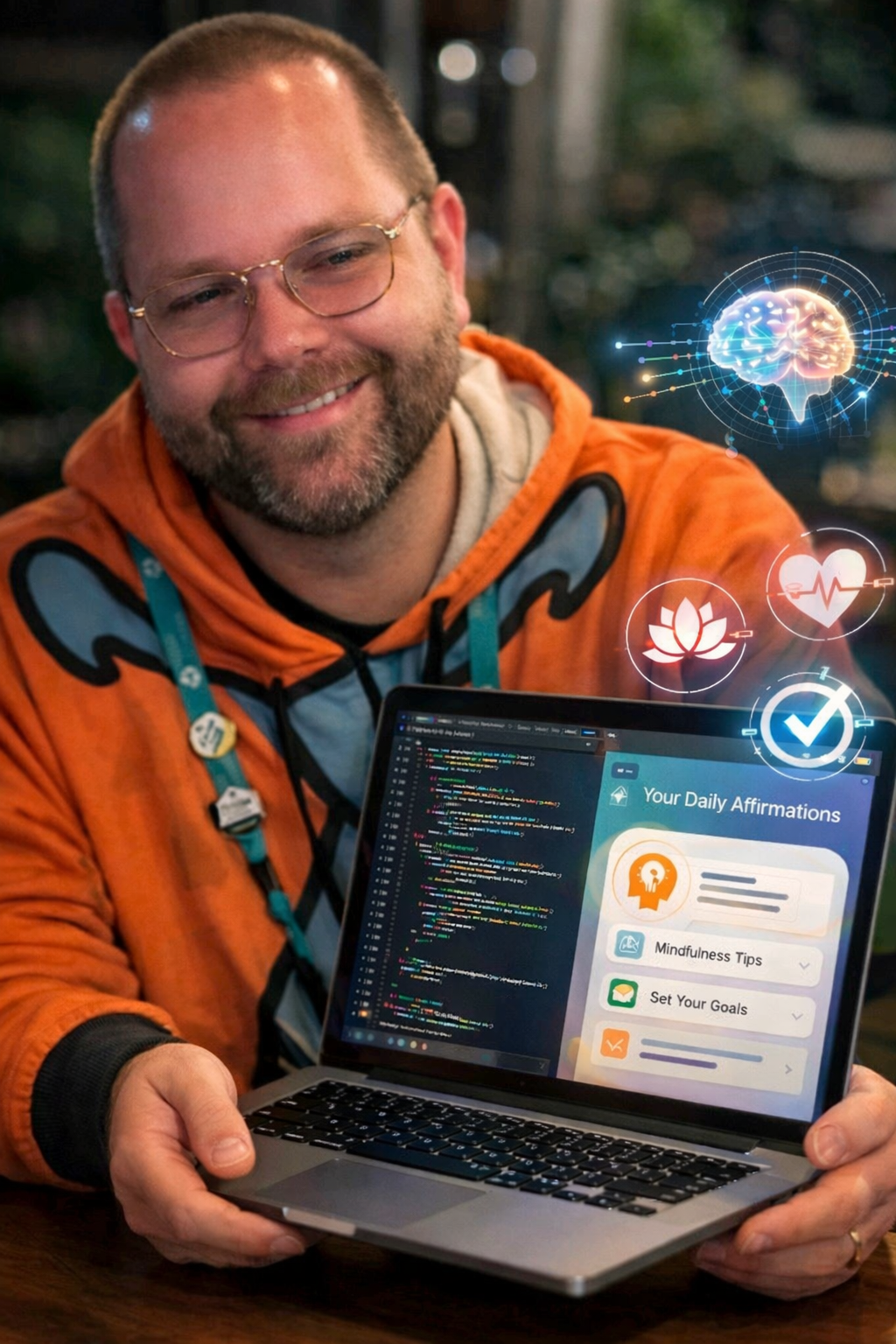
For longer than I’m proud of, I was an AI skeptic. Then, over the holidays, I vibe coded an app whose sole purpose was to make me a better person.
The app is a motivator. It’s programmed to send me timely reminders along certain themes, like reading every day, making healthy eating choices, and giving myself plenty of time to plan for anniversaries and birthdays. It’s made for those little decision moments that add up into big habits: just before you sit down on the couch, when you could either reach for an Xbox controller or a book; or when you open the fridge, when you could either grab something sugary or something nutritious.
I’d been meaning to build it for 10 years. But mobile development is not an area I know well, and I wasn’t motivated enough to learn an entirely new discipline. As with the app’s reminders, it took an external voice — in this case, the urging of a friend and colleague — for me to give AI a shot.
Between Christmas and New Year’s Eve, I built this and many other things. I ran into some stumbling blocks, but I learned that an engineering mindset — where creativity is grounded by practicality — was more than enough to overcome them. Mere tens of dollars later, I had the app that was a decade in the making. Now, I use it every day.
Staying on top of (much less ahead of) the AI curve is not easy. It took me a long time to believe it was necessary, and now that I do, it requires a diverse assortment of daily habits. But it’s not drudgery; the habits are designed to make me engage more deeply with the world around me. The more deeply I engage, the better I understand a world in a period of torrid evolution.
4 Ways I Stay Ahead Of The AI Curve
1. Curated Content Consumption — 30 Minutes Per Day, Every Day
I subscribe to a ton of content creators who produce high-quality work around AI, FinOps, and other tech topics. This content comes in three primary forms:
- Email newsletters (TLDR Tech, The Pragmatic Engineer, Lenny’s Newsletter, Every)
- Website/RSS feeds (Zephyr Globe, Dann Berg, Claude Blog, Microsoft’s FinOps Blog, CloudZero’s blog)
- YouTube channels (FinOps Weekly, CloudZero)
- Podcasts (What’s New In Cloud FinOps, Dwarkesh Podcast)
I don’t find myself looking for high-quality content on X or Bluesky — too much noise there. But subscribing to as many people as I do, I wind up with the digital equivalent of a pile of high-quality newspapers on my doorstep every morning. I prioritize a free half hour of reading daily to dive into what these people have said. 30 minutes of high-quality content per day, every day, is more than enough to keep me informed, even in a space as highly disruptive as AI.
2. Hands-On Experimentation — Build Something I Actually Need
A key indicator of whether something new is going to stick with me is whether it’s practical. It can’t just be cool, I have to get some concrete value out of it. For a long time, this was my concern with AI, that it was good at making headlines, but bad at making a difference.
The motivator app I discussed in the intro is a perfect example of how wrong I was. A willingness to experiment combined with the right mindset led me to build a sort of digital conscience: an application I use every day that actively contributes to making me a better person.
Having built that, I naturally got curious about AI’s ability to improve my work life. Concurrently, CloudZero was about to launch an AI Hub consisting of a Claude Code plugin and an MCP server with nine pre-built FinOps skills. As a FinOps leader, I had a good understanding of my objectives and my constant challenges, and thus, a hypothesis was born: I think this could truly do some magic.
Right away, I used the CloudZero AI Hub to answer some very complex FinOps questions. Specifically, our VP of Engineering wanted to see whether some cost-efficiency initiatives had raised the profitability for two of our biggest customers. I used our MCP server to merge cost and revenue data, organized by customer (thanks CloudZero), and built a report that not only answered his question, but that gave us an ongoing snapshot into profitability per customer, including who’s least profitable, and how each of our platform’s features impact that profitability, along with a whole slew of other data elements I was not expecting and that were equally as valuable.
AI answered a practical question, and it led to a practical process fix. All because someone urged me to experiment, and because I was willing to stumble along the way to success.
3. Community — Diversity Of Perspective Over Depth Of Experience
Ideas on how to experiment don’t just come from my own brain, or from problems I run into at work. They also come from the numerous technical and nontechnical communities I belong to. These include:
-
CloudZero — My brilliant and motivated coworkers.
-
Discord group — I have a Discord group with friends and colleagues from throughout my career. It’s the people who’ve stuck, whose thoughts I always want to hear and whose personalities I always want to engage with.
-
Cortex’s Braintrust — Braintrust is a podcast and a professional community run by Internal Developer Portal company Cortex. It’s similar to my Discord group, except it brings me into contact with amazing thinkers I’d never have met otherwise.
-
The Oxford Review’s “Serendipity Calls” — “Serendipity calls” are monthly live interactive discussions and research reviews hosted by the Oxford Review for its members. It includes people all over the globe, in all disciplines; you’d be amazed at how easy it is to cull technical wisdom from people with nontechnical backgrounds.
-
FinOps communities — I’m a FinOps dude, so FinOps Weekly, and the FinOps Foundation are extremely valuable to me. 4. Nontechnical Reading — The Human Side The technical side of my work has always come easier than the human side. But both sides are equally important. I’m someone who believes strongly in the value of mentorship and of knowledge-sharing; my job is done right not just when I fulfill my obligations, but when I inspire others to engage deeply with their work and their lives.
Learning the human side of work has come not from any technical content — literature, videos, podcasts, etc. — but from nontechnical literature. From novels, from biographies, from stories about people in which you see the human spirit struggling and failing and succeeding in ways that are common to all of us. A few that have helped me include:
- Bury my Heart at Conference Room B by Stan Slap
- Steal the Show by Michael Port
- The 7 Habits of Highly Effective People by Stephen R. Covey
- The Lighthouse Effect by Steve Pemberton
- The 5 Love Languages by Gary Chapman
Childlike Curiosity
I constantly remind myself to be more like a child in the way I approach work. Children approach new things without bias, without prejudice, with nothing but curiosity about how this new thing might enrich their lives And, they ask questions and are not afraid to probe or ask why…why… why.
As an adult, it takes some effort to do what children do naturally. But you can cultivate it by reminding yourself, by committing to staying curious. Stay open to wisdom in sources that you’d expect and that you wouldn’t (there are no stupid questions). AI is a beast, but like anything else, it can be grappled with — the more allies you have in the fight, the better.